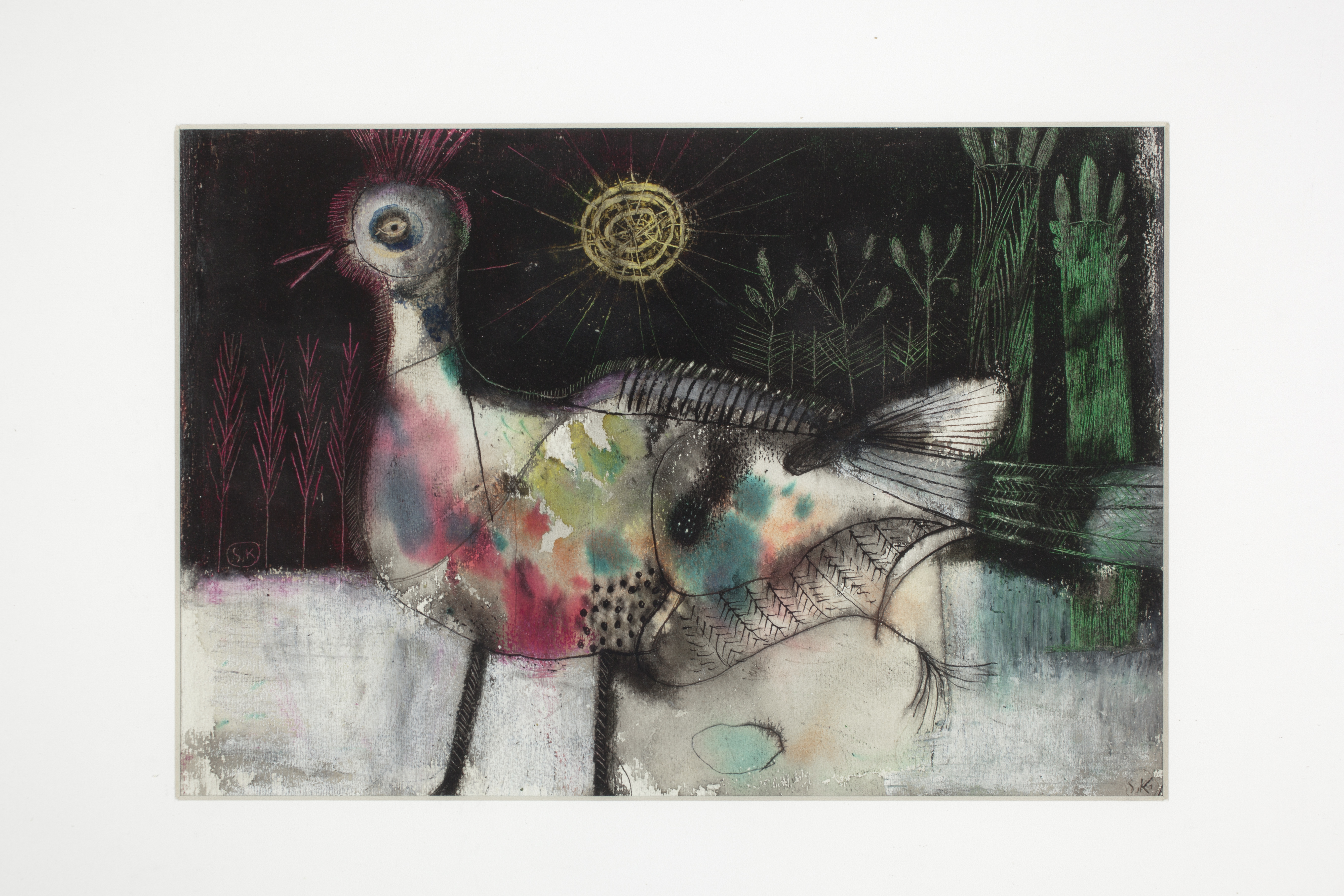
By the wish of the artist Slavko Kopac (1913–1995), the Klovićevi Dvori Gallery became the proud custodian of a remarkable collection of seventy of his works in 1993. Over the years, the collection has been enriched through additional donations, offering a comprehensive overview of Kopac’s artistic journey—from his earliest watercolours depicting Zagreb cityscapes, created after graduating from the Royal Academy of Arts and marking his entry into Croatian modern painting, through works produced during his years in Italy, to the delicate painted sculptures, miniature ceramics, and papier-mâché pieces of the 1960s that embody the mature Parisian period most often associated with his name.
A student of Vladimir Becić and an heir to the artistic legacy of Josip Račić, Miroslav Kraljević, and Marino Tartaglia Junek, the young Kopac approached painting with confidence and freedom, boldly shaping composition while exploring colour, drawing, and painterly gesture. His time in Italy, and especially his move to Paris and encounter with Jean Dubuffet, encouraged him to abandon the conventions of academic art altogether. Kopac’s works became populated by human figures and animals, a benign bestiary of playful idols, everyday objects, and scenes inspired by nature and childhood memories, all arranged in lively compositions and unexpected spatial relationships. His pursuit of spontaneity and immediacy brought him to the very edge of figuration. Colour gained autonomy, liberated from the burden of form; brushwork grew denser, and surfaces increasingly textured and impenetrable. Soon, traditional artistic media were joined by an unlimited range of natural and manufactured materials used in unconventional ways. Sand, earth, cement, and plaster were mixed into paint, while glass, wire, fabric, and even fragments of automobile tyres were applied to wooden supports, creating distinctive layered collages and reliefs. Drawing and paint remained equally important to him, as did the decisive graphic quality of ink and pen and the fluid, elusive nature of watercolour. Through these explorations—layering, collage, imprinting, scratching into surfaces, constant experimentation, and an unceasing search for new possibilities—Kopac eventually moved beyond the picture plane and into the realm of sculpture.
Kopac often said that his works were never truly finished. They are completed by those who look at them. Then another viewer, and another, and all who come after, continue the same game. We invite you to become part of that ongoing dialogue and to enjoy the world of Slavko Kopac’s art.
Gallery